
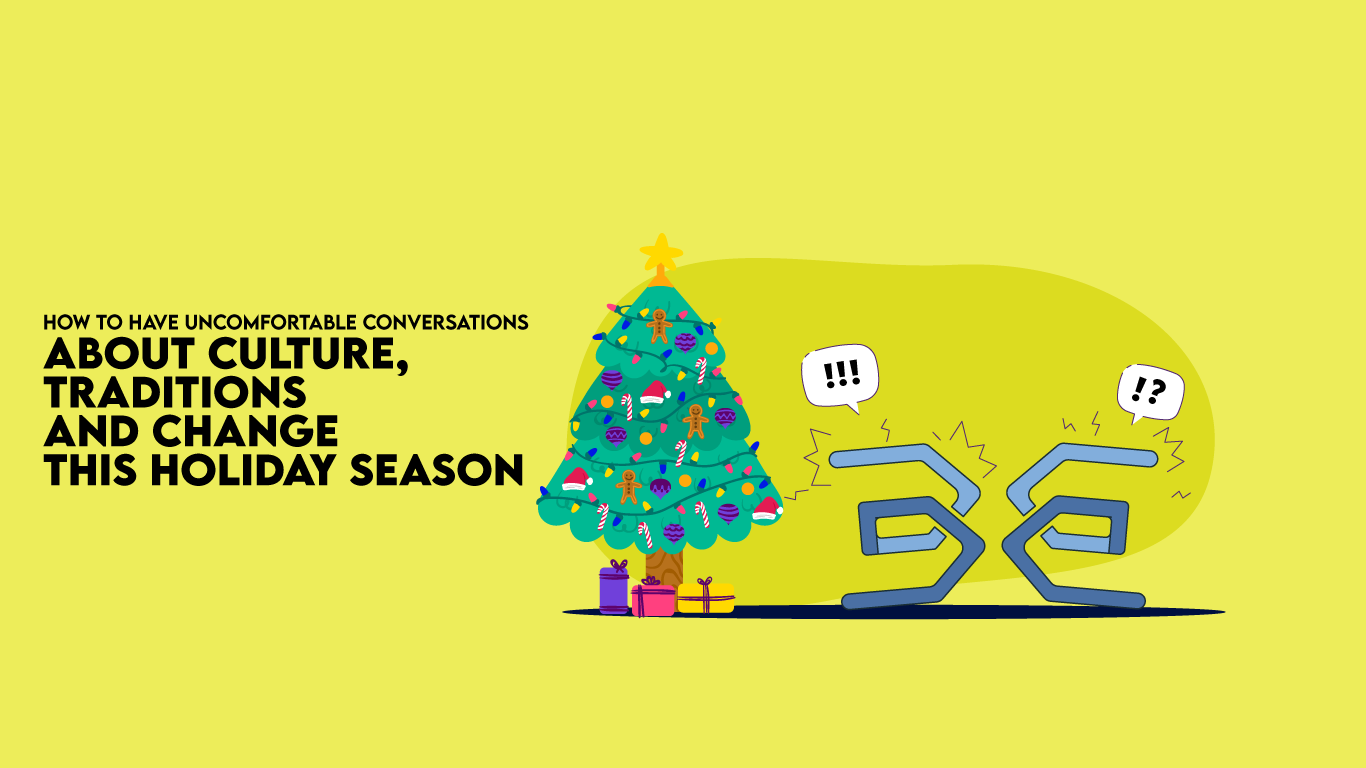
As professional linguists, we know exactly which words to write, which phrases to utter, and which images to design to create perfectly neutral content that won’t offend anyone. We’ve spent over two decades helping organizations communicate across 60+ languages and countless cultural contexts. We could write you the most diplomatically bland holiday guidance you’ve ever read.
But this year, we’re adding our two cents—because sometimes what people need isn’t neutrality. It’s honesty, warmth, and a practical roadmap for those moments when Uncle Bob asks why you’re not celebrating “the traditional way” anymore, or when your college-aged daughter questions traditions you’ve held dear for decades.
The Truth We All Know (But Rarely Say)
Here’s what 20+ years of facilitating cross-cultural communication has taught us: humans are far more alike than we are different. We all want to feel heard. We all get defensive when our values are questioned. We all carry the weight of our own experiences into every conversation. And during the holidays? We’re all exhausted, overstimulated, and surrounded by people who knew us when we were very different versions of ourselves.
Yes, opinions differ. Traditions evolve. Generations see the world through completely different lenses. But underneath it all, we’re working with the same fundamental human operating system—one that craves connection, fears judgment, and desperately wants to be understood.
Before the Conversation: Do Your Own Work
The most important translation work happens before you open your mouth. Ask yourself: What am I actually worried about? Is it that Grandma will judge your parenting choices? That your brother will make a scene? That you’ll be forced to defend a decision you’re not entirely confident about?
Name the fear. It loses power that way.
Also, be honest about your goal. Are you trying to change someone’s mind, or are you trying to maintain a relationship despite disagreement? Because those require entirely different approaches. Most uncomfortable holiday conversations fail because we’re trying to do both simultaneously—and that’s like trying to translate poetry word-for-word. Something essential gets lost.
During the Conversation: Translate, Don’t Transmit
Here’s where our linguistic expertise actually becomes useful. Good translation isn’t about converting words—it’s about bridging meaning across different contexts. The same principle applies to difficult conversations.
When someone says something that makes your blood boil, pause and translate what they might actually mean underneath the clumsy phrasing. “We’ve always done it this way” might translate to “I’m afraid of losing connection to you.” “Kids today are so sensitive” might mean “I’m confused by changing social norms and worried I’ll say the wrong thing.”
This doesn’t mean accepting harmful statements or staying silent in the face of genuine bigotry. But it does mean recognizing that most people—even the ones driving you crazy at the dinner table—are operating from a place of their own fears and values, not malice.
Practice phrases that acknowledge without agreeing: “I can see why you’d feel that way” doesn’t mean you share their view. “That’s interesting—I’ve had a different experience” keeps the door open. “I hear you” is not the same as “I agree with you.”
The Power of “And” Over “But”
We linguists love this one. Watch what happens when you replace “but” with “and” in difficult moments:
“I understand that tradition is important to you, BUT we’re doing things differently” becomes “I understand that tradition is important to you, AND we’re creating new traditions that work for our family.”
That small shift changes everything. “But” negates what came before it. “And” allows both things to be true simultaneously. It’s the linguistic equivalent of making room at the table for everyone.
When to End the Conversation
Sometimes the most culturally competent thing you can do is stop talking. If someone is not listening, not engaging in good faith, or actively trying to hurt you, you don’t owe them an extended dialogue. “I think we’ll have to agree to disagree on this one” is a complete sentence. So is “I’m going to step away from this conversation now.”
Protection is not the same as avoidance. Sometimes the most caring thing you can do—for yourself and for the relationship—is to recognize that this isn’t the right time or place for this discussion.
The Bigger Picture
Here’s what we’ve learned from facilitating thousands of conversations across cultures, languages, and contexts: perfect understanding is a myth. Even with professional interpreters, cultural liaisons, and carefully crafted messages, miscommunication happens. People bring their histories, their hurts, and their hopes to every exchange.
But imperfect communication is still communication. Messy connection is still connection. And showing up to the table—even when you know it’s going to be uncomfortable—is an act of faith in our shared humanity.
This holiday season, you might not change anyone’s mind. You might not find the perfect words. You might leave some conversations feeling frustrated or misunderstood. That’s okay. Because you’re also modeling something important: that we can hold space for disagreement without cutting ties, that we can honor tradition while embracing change, and that we can love people even when we don’t see eye to eye.
Our Professional Advice (The Part We Actually Do Best)
If you’re navigating genuinely complex cultural or linguistic dynamics this holiday season—multilingual families trying to honor multiple traditions, interfaith households negotiating different celebrations, or immigrant families bridging generational and cultural divides—know that these challenges are real and valid. Professional support exists. Cultural mediators, family therapists who specialize in cross-cultural dynamics, and yes, even language service providers who understand the nuances of how meaning shifts across languages and contexts can help.
Sometimes the uncomfortable conversation isn’t with your family—it’s the one where you admit you need help facilitating these discussions. That’s not weakness. That’s wisdom.
The Bottom Line
We’re linguists, not therapists. But we know this: language is a bridge, not a weapon. This holiday season, use it to connect rather than convince, to understand rather than to win. Because at the end of the day, we’re all just humans trying to figure out how to love each other well—even when we disagree about everything else.
And if all else fails, there’s always pie. Everyone agrees on pie.
At Barbier International, we spend our days bridging language and cultural divides for government agencies, school districts, and organizations worldwide. We know a thing or two about navigating difficult conversations—and we know that sometimes, the most important translation work happens right at your own dinner table. From our multilingual, multicultural team to yours: may your holidays be filled with more understanding than arguments, more connection than conflict, and yes, plenty of pie.