
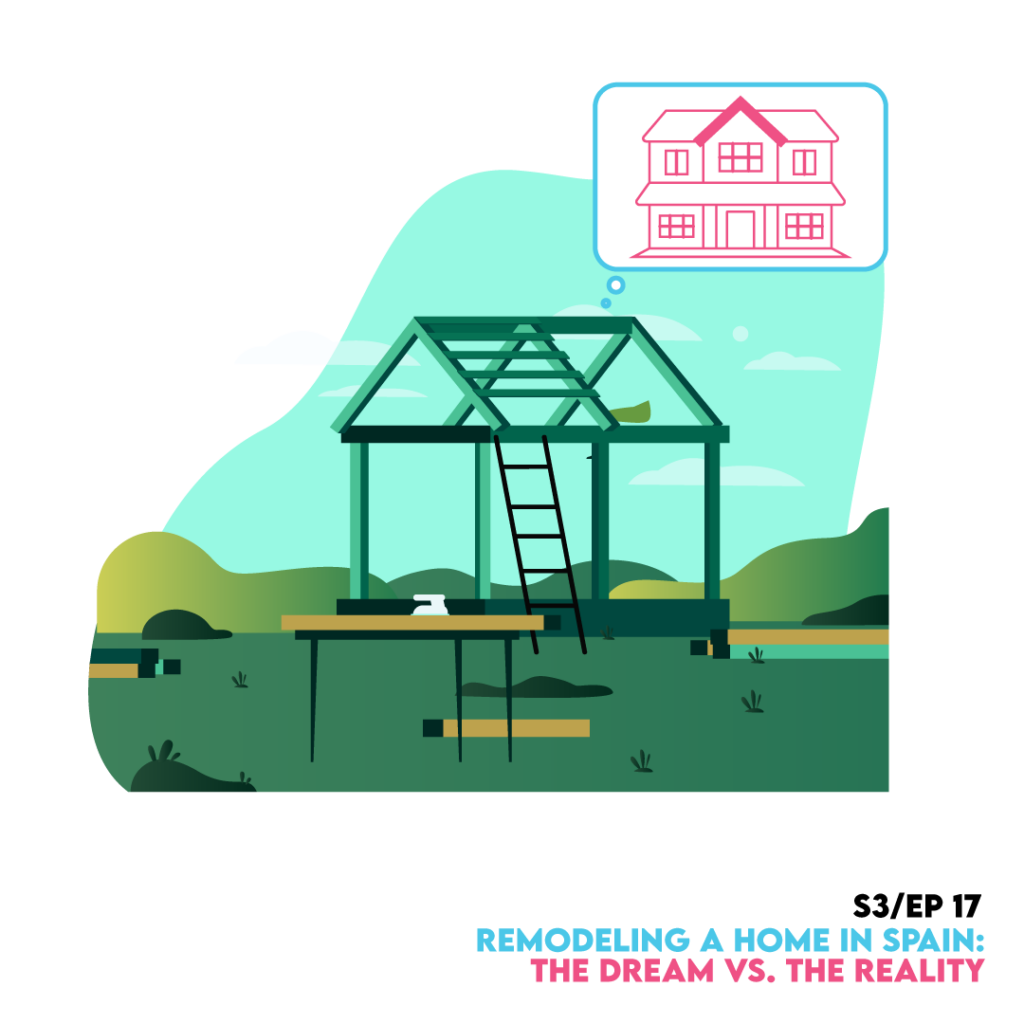
REMODELING A HOME IN SPAIN: MELISSA’S HONEST ASSESSMENT OF WHETHER IT WAS WORTH IT
The dream is seductive: owning a home in Spain, renovating it to your specifications, creating your personal European retreat. The imagery is powerful—sun-drenched terraces, charming local contractors, leisurely renovation timelines, and a beautiful result achieved with manageable effort and reasonable cost. The reality, as Melissa discovered, is significantly more complex. In this week’s episode of Translate This! The Podcast, Melissa shares her real experience remodeling a home in Galicia, Spain—not the Instagram-filtered version, but the actual story with its costs, complications, and challenges. And she wrestles with the central question: Was it worth it?
Galicia: Not Everyone’s Spanish Dream
Before diving into the renovation story, it’s essential to understand the location—because Galicia is not the Spain most people envision when they fantasize about Spanish property. Galicia is Spain’s northwestern region, bordered by the Atlantic Ocean and Portugal. It’s green and often rainy, with a temperate maritime climate that has more in common with Ireland or Brittany than with the Mediterranean. Where most of Spain is hot and dry, Galicia is cool and wet. Where much of Spain is stereotypically associated with flamenco and bullfighting, Galicia has Celtic influences and bagpipe music. The landscape is stunning—dramatic coastlines, lush green hills, ancient forests—but it’s not beach weather most of the year. The culture is rich and distinct, with its own language (Galician), strong culinary traditions (incredible seafood!), and a character separate from the rest of Spain. For some people, this is exactly what they want: a quieter, greener, less touristy Spain with strong cultural identity and natural beauty. For others who dream of endless Mediterranean sunshine, Galicia would be a disappointment. Melissa is clear about this. She’s not marketing Galicia as a universal paradise or claiming it’s objectively superior to other Spanish regions. She’s acknowledging that it’s different, that it appeals to specific sensibilities, and that understanding what you actually want—not the generic “Spanish dream” but the specific daily reality—is crucial before investing in property anywhere. If you’re buying in Spain because you want hot, dry summers and beach culture, Galicia will not deliver that. If you’re buying in Spain because you appreciate green landscapes, dramatic coastlines, Celtic-influenced culture, and a quieter lifestyle, Galicia might be perfect. Know which you want.
The Renovation: Dreams Meet Reality
Melissa’s renovation story includes elements familiar to anyone who’s tackled a major property project, amplified by the complications of doing it in a foreign country.
Budget Surprises (There Were Many)
Renovation projects famously exceed their budgets, but international projects have additional variables. Currency fluctuations can change costs between planning and execution. Material costs vary in ways that are hard to research from abroad. Labor rates may differ from what online resources suggest. Building codes might require different approaches than anticipated. Melissa discovered that the budget that seemed reasonable—even generous—at the project’s start became inadequate as work progressed. Hidden structural issues emerged once walls were opened. Materials that appeared reasonably priced turned out to cost more once all factors were included. Work took longer than estimated, meaning more labor costs. Each surprise chipped away at the buffer until the budget no longer felt comfortable. This isn’t unique to Spain or to Galicia—it’s the nature of renovation. But doing it internationally means less ability to comparison shop, fewer cost-saving options, and more dependence on local contractors’ estimates without the local knowledge to evaluate whether those estimates are reasonable.
The Contractor Challenge
Finding reliable contractors is difficult anywhere. Doing it in a foreign country, potentially across language barriers, with different business practices and cultural expectations about timelines, adds significant complexity. Melissa shares experiences navigating contractor relationships in Spain. Communication could be challenging—not just because of language (though that was sometimes a factor) but because expectations about how work proceeds, how problems are communicated, and what timelines mean can differ across cultures. In some cultures, saying work will be done “next week” is a firm commitment. In others, it’s an optimistic estimate. In still others, it’s a polite way of saying “eventually.” Understanding these differences intellectually doesn’t prevent frustration when you’re waiting for progress that seems inexplicably delayed. Finding contractors who are reliable, skilled, and communicative is partly luck. Melissa had some good experiences and some frustrating ones, which seems typical. But when you’re in a foreign country without extensive local networks, vetting contractors is harder. You’re more dependent on trust and less able to verify claims or check references thoroughly.
Spanish Bureaucracy: A Test of Patience
Anyone who’s dealt with Spanish bureaucracy knows it operates at its own pace and with its own logic. Permits require specific paperwork, submitted to specific offices, processed on timelines that are not always clear or predictable. Inspections need to be scheduled, sometimes with significant wait times. Regulations vary by region and municipality, and finding clear information about requirements can be surprisingly difficult. For someone accustomed to (relatively) streamlined administrative processes in other countries, Spanish bureaucracy can be shocking. Things that seem like they should be straightforward become multi-step processes requiring patience, persistence, and sometimes physical presence at government offices during limited hours. Melissa’s stories about navigating permits and inspections will resonate with anyone who’s dealt with foreign administrative systems and wondered if there was some secret knowledge that would make the process less baffling. (Spoiler: there isn’t. You just have to persist.) The bureaucratic dimension of international property renovation is often underestimated. It’s not glamorous, it’s rarely dramatic, but it consumes time, creates stress, and can delay projects significantly.
Long-Distance Complications
If Melissa wasn’t living at the property full-time during renovation (or if she had to travel even if she was living there), the distance element created additional stress. When renovating locally, you can stop by the property, check progress, address problems immediately, and maintain regular communication with contractors through site visits. When renovating from a distance—whether that’s another country or even just another region—you lose that immediacy. Problems that could be resolved with a quick site visit become coordination challenges. You need photos or video calls to understand what’s happening. You’re dependent on contractors to communicate issues rather than discovering them yourself. Time zone differences can delay communication. And the anxiety of not being able to physically see what’s happening, to verify progress, to catch problems early, creates significant stress. This aspect of international property renovation is often overlooked in the romanticized versions. The dream is being there, watching your Spanish home transform. The reality might be coordinating from a distance, hoping contractors are handling things appropriately, and worrying about what you’re not seeing.
Moments of Doubt
Melissa is refreshingly honest about the times she questioned the entire project. When costs had exceeded the budget by a significant margin, when timelines had stretched far beyond initial estimates, when problems seemed to multiply—there were moments when the whole endeavor felt like a massive mistake. She wondered if she was crazy to have started. She questioned whether the end result would justify the difficulty. She considered whether she should cut her losses. These moments of doubt are part of any challenging project, but they’re rarely discussed in the polished “we renovated in Spain!” stories that populate social media and lifestyle magazines. Sharing these doubts is important because it normalizes the difficulty. Renovation is hard. International renovation is harder. Having moments where you question your judgment doesn’t mean you made the wrong choice—it means you’re human and dealing with a genuinely difficult situation.
Why Galicia Isn’t Everyone’s Dream
Throughout the episode, Melissa returns to the theme that Galicia—and by extension, this entire project—isn’t universal in its appeal. Some people hear “home in Spain” and imagine endless sunshine, beach access, and Mediterranean lifestyle. Galicia doesn’t offer that. It offers green landscapes, dramatic Atlantic coastlines, rain, temperate weather, Celtic-influenced culture, and a quieter existence. For people who value those things, Galicia is wonderful. For people who want stereotypical sunny Spain, it’s the wrong choice. And there’s no objective answer about which is “better”—it depends entirely on what you want from the experience. Melissa’s honesty about this helps listeners think more carefully about their own desires. If you’re dreaming of Spanish property, which Spain are you actually imagining? Have you thought beyond the generic “Spanish dream” to the specific daily reality of different regions? Does your fantasy match what particular locations actually offer? This matters enormously. Buying property based on a generic dream rather than specific understanding of location characteristics is a recipe for disappointment.
So… Was It Worth It?
After all the costs, challenges, stress, and doubt—was the project worth it? Melissa’s answer is complex, as it should be. In purely financial terms, renovation projects rarely make sense. You almost never get back what you invest. The money could have been used differently, invested elsewhere, or saved. From a strict economic standpoint, the answer might be no. In terms of stress and difficulty, the project was harder than Melissa anticipated. If the question is “was it easy?” the answer is definitely no. If someone could have told her at the start everything that would go wrong, would she have proceeded? Maybe not. But those aren’t the only measures of worth. Melissa gained a property in a place she deliberately chose. She has a space that’s hers in a part of the world she values. She gained deeper understanding of Spanish culture, administrative systems, and ways of doing things. She built connections with people in Galicia. She has the satisfaction of completing a difficult project despite obstacles. She created something meaningful. “Worth it” depends on what you value. If you measure in purely financial terms or stress levels, international property renovation often doesn’t make sense. But if you measure in personal meaning, cultural connection, sense of accomplishment, and the value of creating something despite difficulty, it might absolutely be worth it. Melissa doesn’t offer a universal answer because there isn’t one. Instead, she invites listeners to think about their own values, resources, and tolerance for difficulty. Would you be willing to endure the challenges she describes for the outcome she achieved? That answer will differ for each person.
Who Should (and Shouldn’t) Consider International Property Renovation
Melissa’s experience suggests some considerations for anyone contemplating similar projects: You might thrive if you:
Have realistic budgets with significant buffers Can tolerate uncertainty and changing plans Don’t need constant control or immediate resolution of problems Value the journey as much as the destination Have patience for bureaucracy and administrative processes Can communicate across language and cultural differences Are motivated by the meaning of the project beyond financial return
You might struggle if you:
Need strict budget adherence and predictable costs Require clear timelines and expect projects to finish on schedule Need frequent updates and constant visibility into progress Become extremely stressed by uncertainty or changing circumstances Have limited patience for administrative complexity Expect processes to work the way they do in your home country Are primarily motivated by financial return on investment
Neither profile is better or worse—they’re just different. Understanding your own tolerance for the challenges Melissa describes helps determine whether international property renovation aligns with your capacities and values.
The Value of Honest Storytelling
What makes Melissa’s episode valuable is its honesty. She doesn’t romanticize the experience or pretend it was easier than it was. She doesn’t end with a neat conclusion where everything worked out perfectly and all the difficulty was worthwhile. Instead, she shares the complicated truth: it was harder than expected, more expensive than planned, and more stressful than imagined—and yet, despite all that, she values what she created and the experience she gained. This nuanced reflection serves listeners far better than either “it was a disaster, don’t do it” or “it was perfect, you should too!” Real experience is nuanced. Real decisions involve trade-offs. Real outcomes include both difficulties and rewards. For anyone considering international property purchase or renovation, Melissa’s story is essential listening. It won’t tell you what to decide, but it will help you decide with realistic understanding of what you’re contemplating. Because the dream of a home in Spain is seductive. But dreams realized through difficulty, expense, and persistence—those have a different quality than fantasies. Sometimes they’re better, because they’re real.