Let’s say plainly what this industry rarely says out loud.
People are harmed when language access fails. Not as a metaphor. Not as a liability talking point. As a documented, peer-reviewed, auditable fact.
In one of the most cited cases in medical literature, a young man was brought to an emergency room. His family used a Spanish word meaning “sick from ingestion” to describe his condition. An untrained bilingual interpreted it as “intoxicated.” He was treated for a drug overdose. He was actually experiencing a cerebral hemorrhage. He survived — as a quadriplegic. The lawsuit settled for $71 million.
The professional interpreter for that encounter would have cost under $300.
This is what language access failure looks like at the end of its chain.
The Healthcare Cascade
Language access failure in healthcare doesn’t announce itself. It cascades.
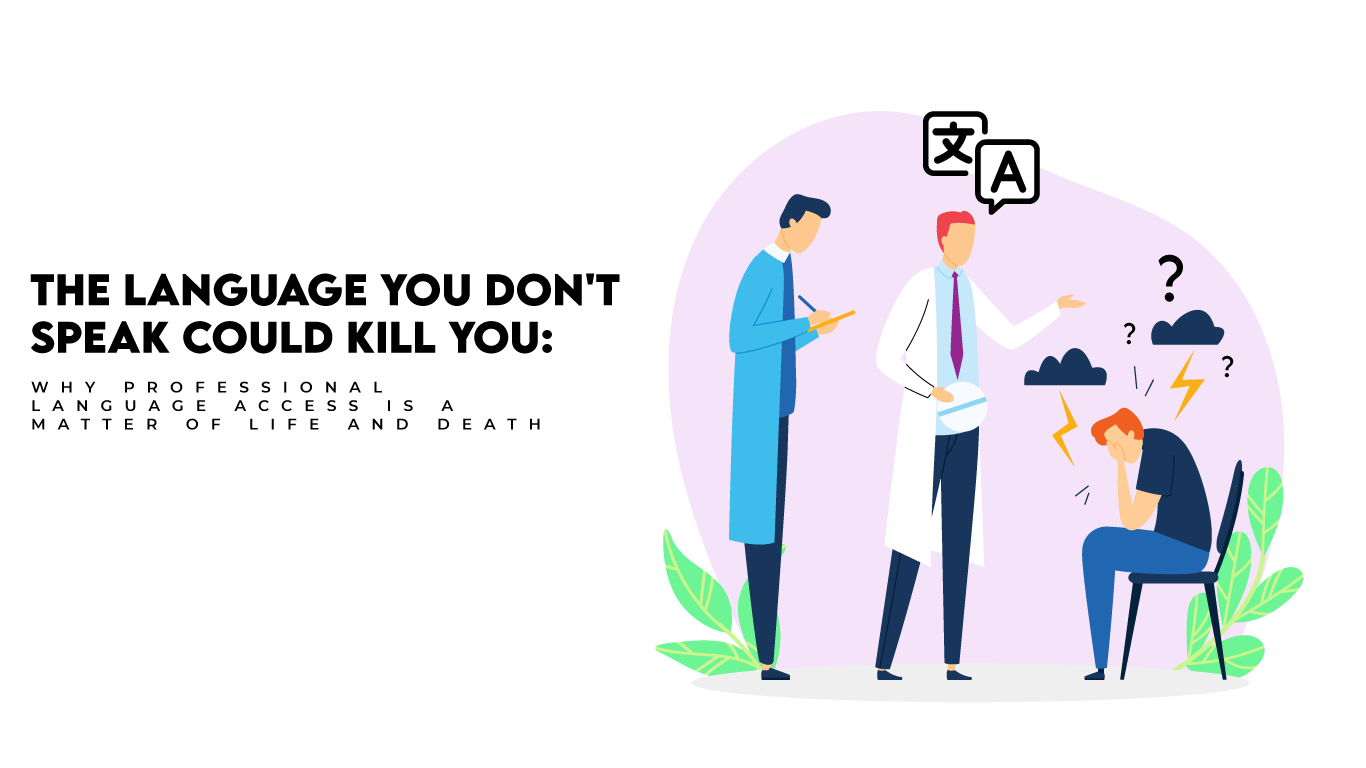
A limited-English-proficient patient sits in a waiting room. A family member is pulled in to interpret — because the hospital didn’t have a certified medical interpreter available, or didn’t schedule one, or assumed the bilingual staff member down the hall would do.
That family member does not know the clinical term for anticoagulant. Doesn’t understand the consent form. Doesn’t know to ask about contraindications. Is also, by the way, terrified — because their loved one is sick, and they are being asked to carry clinical responsibility for which they have no training and no ethical framework.
The error is small at first. Until it isn’t.
Research consistently shows that patients with limited English proficiency who receive professional interpretation have better outcomes, higher medication adherence, and lower rates of adverse events than those who rely on informal bilingual assistance. The difference is not marginal. It is measurable, documented, and preventable.
The Courtroom Cascade
In legal proceedings, the right interpreter is not a courtesy — it is a constitutional question. The right to understand the proceedings against you, to give testimony accurately, to comprehend the terms of a plea — all of this hinges entirely on the quality of language access provided.
A Q’eqchi’ Maya speaker from Guatemala standing before an immigration judge is not served by a general Spanish interpreter. They are served by a credentialed interpreter fluent in Q’eqchi’ — a Mayan language spoken by roughly one million people, most of whom have never had formal institutional language access in any setting in their lives. The differences between Spanish and Q’eqchi’ are not minor. They are categorical.
Barbier International maintains credentialed linguists in Central American Indigenous languages specifically because we have sat with these communities, understood their stakes, and refused to offer a substitution and call it service.
The Classroom Cascade
Federal law requires that limited-English-proficient parents receive meaningful communication from their children’s school districts — in a language they understand, at an accessible literacy level, through competent interpretation and translation services.
The IEP meeting is among the highest-stakes processes a family navigates in the education system. A parent who cannot understand what is being decided about their child’s educational future — who nods through a meeting, signs documents they cannot read, and leaves without knowing what services were approved, denied, or recommended — has been failed by a system that had a legal and moral obligation to them.
That is not a translation failure. That is a civil rights failure with a translation failure at its root.
What Professional Language Access Actually Requires
A professional interpreter is not a bilingual person. This distinction is fundamental and widely ignored.
Professional interpretation requires domain-specific training — medical, legal, educational, community. It requires ethical standards: neutrality, accuracy, completeness, confidentiality. It requires cultural competency that goes beyond vocabulary. It requires protocols for managing emotionally charged encounters, for requesting clarification without disrupting the flow of care or proceedings, for recognizing when a situation exceeds scope.
Credentialing through recognized bodies — CCHI, RID, court certification programs, healthcare-specific credentials — is not bureaucratic overhead. It is the documented evidence that someone is actually qualified to hold the weight of another person’s life in their words.
The Barbier Commitment
We built our linguist network — 4,000+ credentialed professionals across 200+ languages — because we understood these stakes before they became a headline.
We pursued ISO 17100 and ASTM F2575 certification because the communities we serve deserve a documented quality process, not a vendor’s verbal assurance.
We went deep in Central American Indigenous languages because we saw who was sitting in hospital rooms, standing in courtrooms, and attending IEP meetings with no one in the room who actually spoke their language.
We are not marketing a service. We are holding a standard.
Because on the other side of that standard, the silence costs more than any invoice we will ever send.
Be Better. Be Barbier.®