
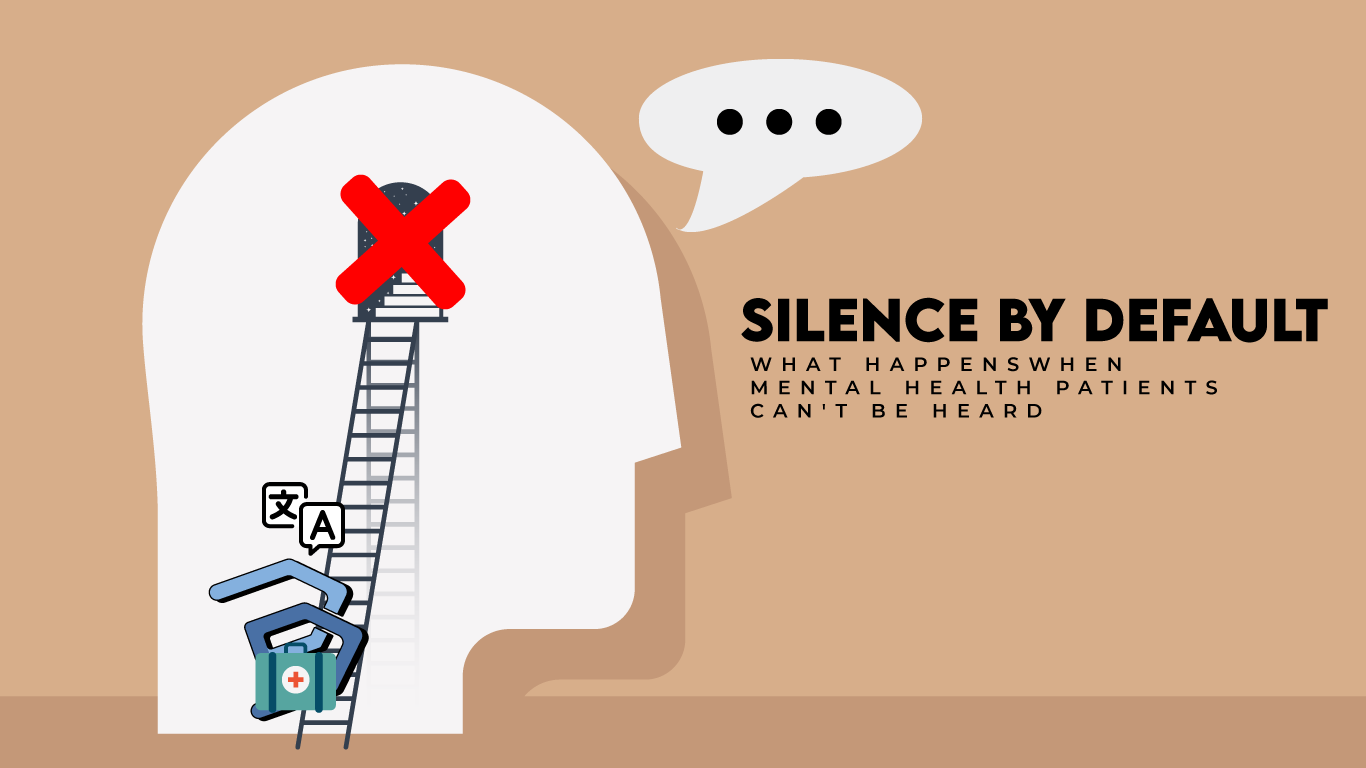
The world is finally talking about mental health, but there is still a conversation that isn’t being had loudly enough, what happens when a patient and their provider don’t share a common language.
The conversation around mental health has been growing for decades and for good reason. Since 1949, Mental Health America has championed a movement built on one simple but powerful belief: that mental health matters, that stigma must be challenged, and that no one should have to face their struggles alone. And looking at the world today, it is clear that this work is far from done. The COVID-19 pandemic shook our collective mental health to its core, leaving behind waves of anxiety, grief, and isolation that many are still navigating today. At the same time, technology is evolving at a pace that no regulation has been able to keep up, social media algorithms, artificial intelligence, and the always-on digital world are quietly reshaping the way we think, feel, and connect, often without any safeguards for our mental wellbeing.
Think about what it really means for you, for me, for anyone who has ever needed to reach out for mental health support but couldn’t find the words in a language someone else could understand. This is not a small inconvenience. This is a wall. A wall that can stop someone from communicating a depression that has been building for months, from describing an anxiety attack in the middle of the night, from naming the burnout that has been quietly consuming them. And I say “us” intentionally, because mental health is no longer a luxury that some people get to care about. It is a basic human need, as fundamental as any other medical service.
For people with limited English proficiency, the road to care is already full of obstacles that go far beyond finding an available appointment. The barrier starts the moment they try to reach out, the moment they need to put their feelings, their fears, and their most intrusive thoughts into words that someone else can actually hear. Behind every statistic, there is a person. According to the U.S. Census Bureau’s American Community Survey, more than 67 million people in the United States speak a language other than English at home and over 25 million of them are considered limited English proficient, meaning they face every doctor’s visit, every form, every phone call in a language that is not their own. The National Alliance on Mental Illness (NAMI), the nation’s leading mental health advocacy organization, reports that 1 in 5 adults will experience a mental illness in any given year. That means right now, today, there are millions of people who need mental health care and cannot fully communicate what they are going through.
67M+ people in the U.S. speak a language other than English at home. Source: U.S. Census Bureau — Language Use in the United States: 2019 (American Community Survey)
25M+ are classified as limited English proficient (LEP). Source: Migration Policy Institute, based on U.S. Census Bureau ACS data
1 in 5 adults experience a mental illness in any given year. Source: NAMI, sourced from SAMHSA, CDC & NIMH nami.org/mental-health-by-the-numbers
When we look at this reality, it becomes clear that we are facing a genuine equity challenge and one where linguistic services companies and providers hold a key position in driving meaningful change. In the world of mental health, a professional evaluating a patient must be able to do far more than translate words. They must understand how those words are shaped by geography, culture, and lived experience. The way a person expresses sadness, stress, anxiety, depression, or trauma varies enormously from one culture to another, from one region to another. And when that understanding breaks down, the consequences are not just clinical, they are deeply human. We are talking about misdiagnoses that go unaddressed, about people who suffer in silence because no one could understand what they were trying to say, and in the most devastating cases, lives lost because the system simply could not reach them.
This is where the true value of professional interpreters and translators becomes undeniable. In a mental health context, a qualified interpreter must go far beyond language fluency. They must provide both the patient and the clinician with something far more valuable: the certainty that they are truly understanding each other. That requires a deep command of clinical terminology, a sophisticated awareness of cultural nuance, and above all, an unwavering ethical commitment to conveying meaning with complete fidelity particularly in high-risk situations where the accuracy of a single sentence can change the course of someone’s care, or their life.
In Barbier International, we advocate not only for mental health awareness but for something equally fundamental: the right to access mental health services, regardless of the language you speak. Too often, mental health providers operate with limited budgets and lean administrative infrastructure, leaving them without the language access programs their patients desperately need and the result is direct and harmful: people with limited English proficiency receive lower quality care, or no care at all. Not because services don’t exist, but because those services were never made accessible to them.
For many immigrant and refugee communities, the road to care is made even harder by the weight of cultural stigma. Therapy is not always seen as help it can be seen as shame, as weakness, as something that belongs to another world. A professional interpreter who understands this who can navigate not just the words but the unspoken cultural reality around them can open a door that nothing else can.
This is precisely the gap that professional linguistic services are uniquely positioned to fill. We have the tools. Barbier International has the expertise. And now, more than ever, we have the responsibility to use them where they matter most. Mental health care without language access is incomplete care and incomplete care is a gap we can no longer afford to accept. Barbier call is simple but urgent: let’s close that gap. Not tomorrow. Now. Because every person who walks into a mental health setting deserves to be fully heard in their language, within their culture, and with the dignity every human being is owed.
The most powerful thing Barbier can offer another human being is the certainty that they have been truly understood. In mental health care, that certainty begins with language, and it has the power to change, and save, lives. Be Better Be Barbier.